Peitro Celi is a veterinarian with a wealth of academic and practical knowledge, and is currently employed as the APAC Ruminant Technical Manager for ADM, as well as an honorary Senior Fellow at the University of Melbourne. This presentation focuses on a niche yet critical (and fascinating!) topic relating to oxidative stress. Pietro poses a key question in this presentation – Oxidative ‘Stress’ or Oxidative ‘Status’? The same? No! Pietro defines oxidative status as Redox Balance and, oxidative stress = oxidative damage. Redox balance has a role in regulation of animal function and reproduction. Oxidative stress influences animal health.
Oxidative status is a balance between production of reactive species (ROS – Reactive oxygen species or / and RNS – Reactive nitrogen species) and the bodies ability to detoxify these with enzymatic or non-enzymatic antioxidant defences. Just what happens when the production of ROS/RNS overwhelm antioxidant defence mechanisms? To help answer this, Pietro steps us through the sources of ROS including but not limited to hydrogen peroxide, superoxide anion and hydroxyl radical, and sources of RNS such as nitric oxide, nitrogen dioxide and peroxynitrile.
Free radicals (the ‘bad guys’) and some key antioxidants that offset damage caused by free radicals are defined. The main functions of antioxidants are listed (as well as cellular locations of these). You’ll recognise some of antioxidants including A and Vitamin C, Glutathione and selenium – but you’ll learn about news ones that might be completely new to you. Useful tables are provided to show us the best feed sources of these antioxidants. Quantitative examples (for pigs and lactating vs. non-lactating cows) are given for redox balance and oxygen consumption, including showing how oxygen is converted into compounds that perturb metabolic functions such as calcium homeostasis and energy metabolism.
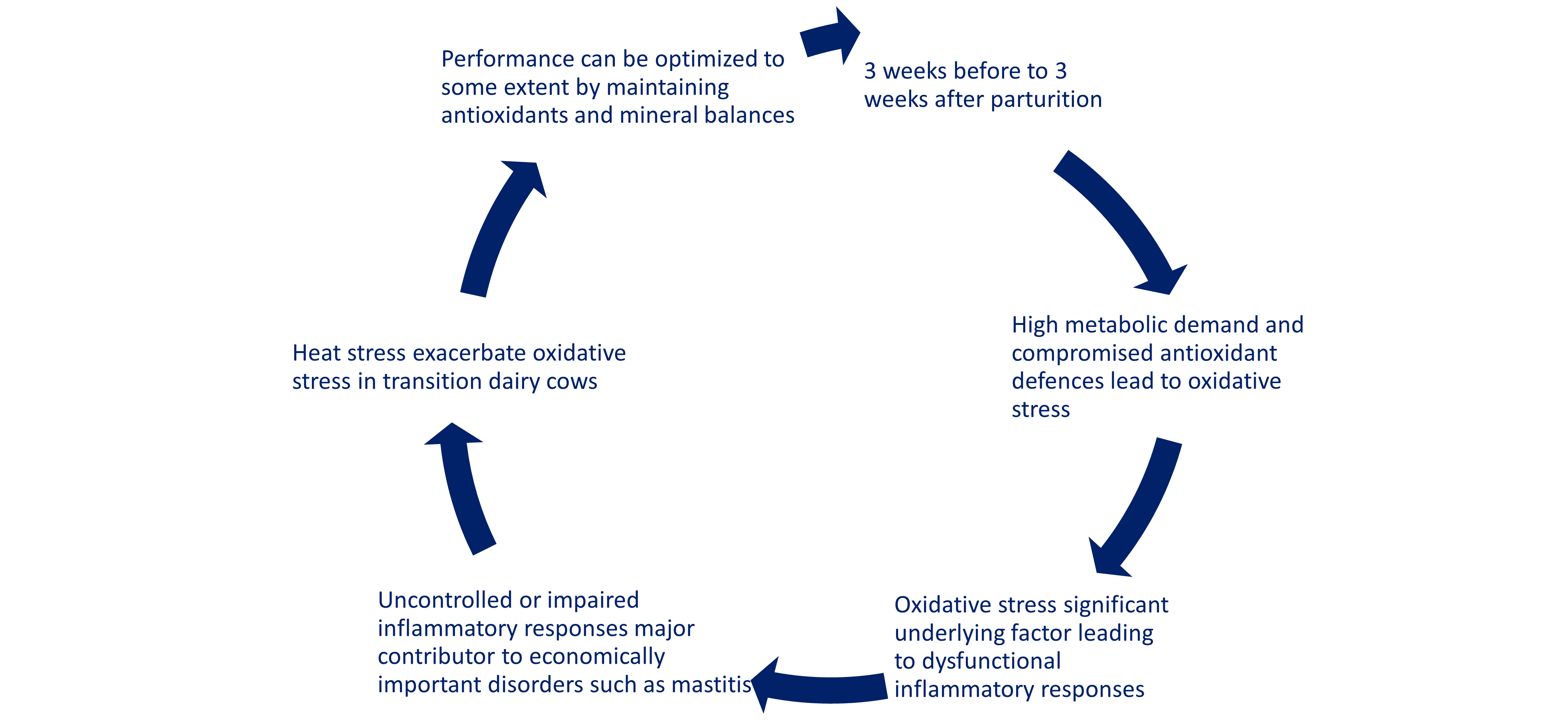
Feed type and antioxidant intake: Lack of green pasture (great source of antioxidants) through drought and winters places animals at greater risk of oxidative stress compared with animals eating lush green spring pastures. Within dairy systems, the transition period oxidative stress is highly likely, leading to dysfunctional inflammatory responses, contributing to eg. Mastitis – accentuated by e.g. Heat stress.
Methods to assess oxidative stress are defined via oxidative stress markers in blood. Calf data showed how oxidative stress changes as calves age from 0 weeks through to week 18. At birth, markers for oxidative stress are high, then drop low then lift again in older calves – likely weaning related. For cows, links between oxidative stress (based on markers of oxidative stress) and AI outcome (as assessed based on P4 and PAG concentrations) shows oxidative stress can reduce reproductive success.
Heat stress and oxidative stress. Heat – a lactating cow producing 5L of milk yields the same amount of heat as one light bulb. Who would have thought?! To rid a cow of heat, a metabolic cost is incurred that otherwise would have yielded milk, and dry matter intake is negatively impacted. Pietro show an amazing diagram summarising how heat stress impacts on a cow – well worth a look, no wonder hot cows suffer (many effects, well beyond oxidative stress). Multiple antioxidant strategies are listed to help hot cows, with the mechanisms of each explained by Pietri. The additive / synergistic modes of action of multiple antioxidants are discussed.
Pietro Celi graduated in Veterinary Medicine at the University of Bari (Italy), moved to Perth, Western Australia, to complete a PhD in Animal Science (University of Western Australia). In 2000 he took a lectureship position in Animal Physiology at the University of Basilicata (Potenza, Italy) and in 2005 he joined the University of Sydney as Senior Lecturer in Ruminant Health and Production. In 2015 he transitioned into the private sector taking on Technical and Commercial roles with dsm-firmenich (Global Science Lead Eubiotics and Manager Performance Solutions, Oceania) and Adisseo (Regional Category Manager Ruminants and Palatability and ANZ and Pacific Islands Territory Manager). He is currently the APAC Ruminant Technical Manager for ADM and honorary Senior Fellow at the University of Melbourne (Australia). He has been invited speaker to over 50 national and International Conferences, workshops, and seminars, including key international events relevant to industry and academia. Dr Celi has been involved in studies into animal physiology, nutrition and reproduction for over 25 years and during this time he has worked on a variety of livestock species. Dr Celi has published 150 peer reviewed journal papers, 4 book chapters and over 160 conference papers related to animal nutrition and health (full list of papers can be found at https://www.researchgate.net/profile/Pietro_Celi and https://scholar.google.com/citations?user=pptcOxYAAAAJ&hl=en). He is Editorial Board member for Journal of Dairy Research.
NZARN members a copy of the presentation is available below if you are logged in.
Non-members looking for more information are encouraged to use our ‘contact a nutritionist’ form and ‘member directory’ to find a member who can help them answer their questions.
If you are a Rural Professional interested in joining the NZARN please see our ‘membership’ section.