Louise Salter is a Performance Specialist with CowManager New Zealand and an animal nutrition and dairy industry professional with more than 25 years of experience across New Zealand and the United Kingdom.
Holding a Bachelor of Agricultural Science (Hons) in Animal Science from the University of Edinburgh, Louise achieved Full Australian Association of Ruminant Nutritionist accreditation (AARNe) by examination in 2022 and is a Full Member of the New Zealand Association of Ruminant Nutritionists (NZARN).
Throughout her career, Louise has worked across animal nutrition, precision livestock technology, breeding, product development, technical training, and commercial advisory roles. Her experience includes positions with CowManager, Nutritech, DeLaval, Cogent Breeding, and Worldwide Sires, where she has helped farmers, nutritionists, veterinarians, and industry professionals improve animal health, productivity, and profitability through practical, data-driven decision making.
Louise has a particular interest in the integration of nutrition, animal health, and precision monitoring technologies, with a focus on translating complex data into meaningful on-farm outcomes. She is a regular contributor to technical publications and enjoys collaborating with industry stakeholders to advance the understanding and application of ruminant nutrition in modern dairy systems
With 14% or more of NZ dairy herds adopting cow wearables, Louise Salter challenged us to better utilise data from wearables, specifically to improve herd reproductive performance. Given the often perplexing associations between nutrition and reproduction in dairy cows, Louise identified that as an industry, we’re not (yet) utilising wearable data to improve the fertility outcomes of herds. Data from 2024 (LIC) suggested that herds using wearables have yet to demonstrate improved reproductive performance compared to that from non-wearable herds. How can we improve reproductive performance using wearable data, with a focus on the role for improved nutrition of cows?
Louise provided practical tips and tricks around data use. An opportunity exists to align wearable alerts with reproductive outcomes by allowing early, proactive interventions to address nutritionally-based challenges. The ‘planned’ vs. ‘actual’ diet can be assessed by cow wearables to assess variance between planned and actual. Nutritionists working on farm can and should access these data for clients and respond accordingly.
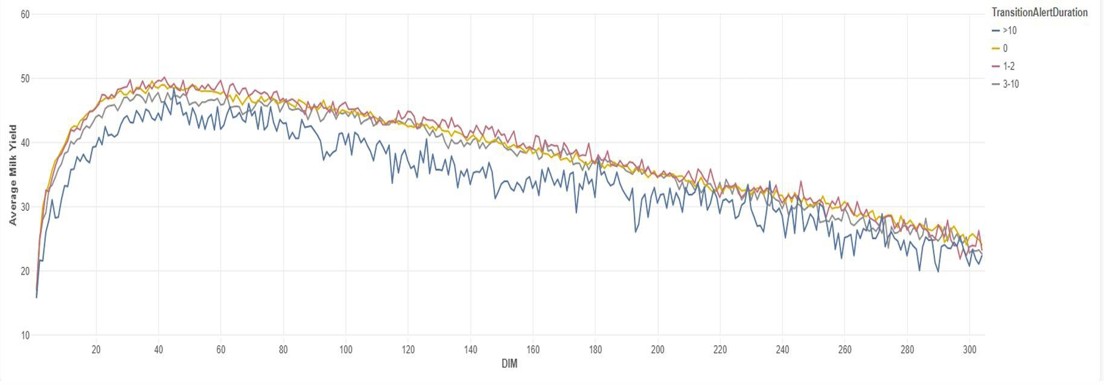
Be proactive and address why pre-calving rumination rates are low before production and reproductive outcomes are impacted. Using a case study, Louise illustrated the principles of monitoring periparturient rumination and activity (including the intersect between these two metrics). Louise stressed that it’s not only about monitoring rumination at a single point in time, but importantly the rate of rumination recovery after calving. Data can be investigated for different cow cohorts, e.g. by age to identify at risk groups more likely to fail reproductively. One specific example was rumination vs. time to first heat post-calving and therefore prevalence of non-cyclers. The more heats before mating is associated with improved conception rate at first mating therefore earlier onset of cyclicity influences both submission but also conception rate.
Adoption of new technology is one thing, the more important opportunity for us is to strategically interpret and act on data generated from technology – a really good opportunity for all nutritionists.
NZARN members a copy of the presentation is available below if you are logged in.
Non-members looking for more information are encouraged to use our ‘contact a nutritionist’ form and ‘member directory’ to find a member who can help them answer their questions.
If you are a Rural Professional interested in joining the NZARN please see our ‘membership’ section.