Nick Hand, Senior Account Manager for Halter, covering West Coast/Tasman for Halter. He have been with Halter 3 years, previously a farm consultant in Canterbury, and some environmental consulting in Canterbury as well. He is passionate about pasture and profitability, love to use data to drive change. Lives on a lifestyle block just South of Greymouth with his wife and 2 daughters. Any spare time is consumed by running, fishing and woodworking.
Nick gave a brief overview of the Halter journey to date before challenging us with an opportunity to improve pasture management utilising virtual fencing. More than simply an opportunity to “drop a labour requirement”, virtual fencing offers improved pasture utilisation benefits, in addition to standard heat and health monitoring, and rumination and activity tracking.
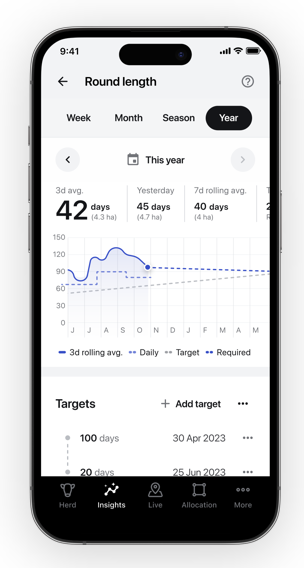
Many farmers don’t measure or monitor pasture as they should; Halter can potentially improve pasture management, largely via tracking and adjusting pasture management in real time. The farmer sets targets e.g. for post-grazing residuals (Halter is not a prescriptive system with specific, defined target pre and post grazing masses). Live and real time pasture targets are set, with associated adjustments as needed. A forecasted feed wedge is generated, with any dietary manipulations incorporated within the feed wedge. The DairyNZ Feedchecker program is built into the Halter system, tracking MJME supply and demand on a real time basis. Rumination and grazing metrics are overlaid on the MJME supplied vs. demand. The Feedchecker approach can be manually overridden by the farmer / consultant as required.
Milk production data can be overlaid with rumination and activity (grazing), with options to monitor changes in grazing and feeding vs. milk production.
Other external forces e.g. a forecast southerly weather change (and associated impacts on milk production) can be matched with e.g. increased MJME offered via virtual fencing when the weather is due to change for the worse. Some farmers are using virtual fencing to influence nutrient return / better distribute urine and faeces across a paddock, not camped in one spot.
Virtual break placement can be changed in real time. Cows can be shifted within or between paddocks if e.g. post graze residuals have been reached, providing options for cows to consume more feed (via more accurate pasture allocation). Similarly, cows can be moved on in rain events to minimise pasture damage.
Post grazing residuals are set by the farmer and are monitored by the farmers in addition to Halters assessment of residuals (assess by eye, or rising plate meter). A photo residual tool is included, for junior staff to take photos then measure residual, so that decision-making staff can manually check residuals. Farmers who don’t manually monitor post-grazing residuals are more likely to have greater day to day variation in post-grazing residuals than farmers who manually check post-grazing residuals.
Colostrum cows benefit from virtual fencing, with regular “little-and-often” pasture allocation can encourage higher DM intakes by colostrum cows. For milkers, in many cows can be shifting milkers multiple times a day to drive DM intakes, to reduce between-cow competition for feed with 24 hour grazing or 12 hour breaks.
Numbers of emergent leaves on ryegrass at the point of pregrazing is assessed by the Halter system and data makes us rethink the 3-leaf rule for ryegrasses. When targeting 2800kgDM/ha pre graze mass, Halter data concludes that leaf emergence stage is averaging 2.3 leaves, not 3.0 leaves as is the industry “target” pregrazing mass. Massey and Lincoln academics have been consulted regarding this lower leaf emergence stage, concluding that perhaps higher N use in NZ pastoral systems is involved with this observation. Nitrogen has no impact on emergence of leaves, but does impact size of leaves (larger with N). If under higher N applications we were to wait truly for full emergent 3 leaves, covers may be in excess of 3500kgDM/ha. Leaf stage at pregraze mass changes by region. For irrigated Canterbury farms through spring and early summer, pregrazing pastures are averaging 1.8 leaves/tiller (faster grazing round length) vs. dryland dairying regions, pregrazing mass is closer to 3 leaves/tillers (slower grazing round).
With GPS capabilities, cows can be tracked for walking distance, in one case up to 13km per day, with implications for MJME offered to compensate for distance walked and reduced grazing time.
Don’t just adopt new technologies, instead we should be better utilising data in a proactive manner.
NZARN members a copy of the presentation is available below if you are logged in.
Non-members looking for more information are encouraged to use our ‘contact a nutritionist’ form and ‘member directory’ to find a member who can help them answer their questions.
If you are a Rural Professional interested in joining the NZARN please see our ‘membership’ section.